


 Direction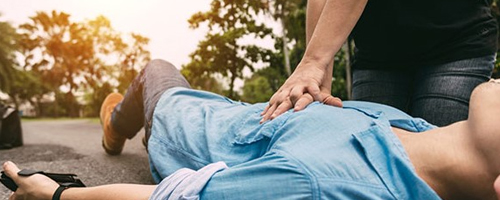
Your Two Hands Can Save A Life
What do you do as a common citizen, when you see someone collapse suddenly, outside the hospital!
Let us understand the philosophy of this situation.
Work of heart is to pump the blood to brain and all important organ and it provides oxygen which is necessary for survival. In cardiac arrest the heart suddenly stops beating and there is cessation of blood circulation. The brain and other organs are deprived of oxygen. If this situation is extended longer then few minutes, there is impending death. By chance this victim survives, the brain is damaged and he or she has permanent inferior quality of life or even total dependency. The causes of cardiac arrest are related to pre-existing medical problems however it can be precipitated by any event or incidence like trauma or drowning etc. The common cause of cardiac arrest is heart rhythm abnormalities or heart attack.
Unfortunately the most sudden cardiac arrests happen away from heath care facilities and at any time of the day. In this situation there are no doctors or paramedics around. If the reason for collapse is “Cardiac arrest” then there is no time even to get the medical help in few minutes.
Prevalence of such event is not frequent, but the magnitude of the problem is so severe, that it needs attention. If bystander or citizen is trained with a technique of cardiac compression, he can initiate rescue procedure, till medical help arrives. This can have a tremendous effect on the outcome of survival.
When a person suffers from cardiac arrest outside of the hospital, , cardiac compression is an appropriate intervention within the first few minutes of a cardiac arrest, until emergency services arrive. “Compression only Life Support” (COLS) is a skill recommended by Indian Resuscitation Council Federation and many similar international resuscitation councils.
Following are the steps of COLS, when a bystander observes that someone has sudden collapse, outside the health care institution..
In this situation, it is most important to check your own safety before approaching the victim. Next step is to check the responsiveness of that victim, by tapping strongly on shoulders and ask “How are you”. If he or she shows response in the form of verbalizing, trying to move limbs, cough, try to open the eyes, starts breathing et, within 10 seconds, that means he dose not have cardiac arrest. These are the signs of life. But if he or she does not respond in this form, immediately call for the medical helpline number and describe the situation. In India 108 is the helpline number for medical emergency.
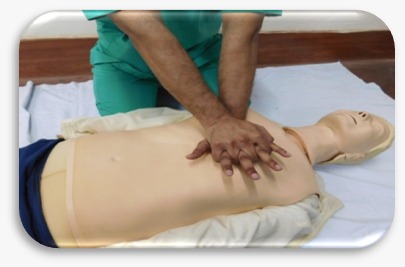
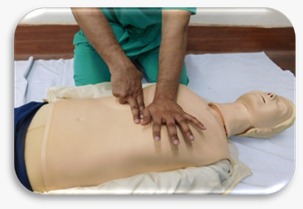
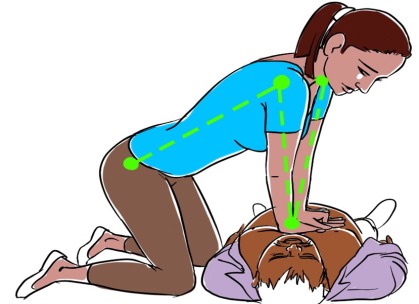
Begin the chest compression at the rate of 120 per minute. Make 5 set of 30 compressions each and continue for 5 sets. At the end of 5 sets again check for responsiveness. The chest compression is performed with both hands placed on the chest as show in the picture. The heel of one hand is placed on the centre of the person’s chest and the other hand on top. Interlock your fingers and pressed down with the heel of your hand, keeping the elbows straight. Keep compressing the chest at the rate of 120 per minute, in 5 sets of 30 compressions each, counting loudly. Continue till the medical help arrives.
When we see someone collapsing, to help the victim, we need the desire or willingness, courage and correct technique to perform Compression only Life Support. Your little awareness and efforts can change the situation and make a difference in the life of that victim and the family. Not only that you prove yourself a hero in the society too.
The motto of Indian Resuscitation Council Federation is to make Every Citizen a Lifesaver. We postulated the technic of Compression only Life Support (COLS) where a layperson can perform Cardiopulmonary resuscitation with his two hands outside the hospital. 16th October is declared as ‘World restart A Heart Day’ (WRAH) and over 675,000 lay persons were trained in 2018 across the world including India.
I request everyone to explore the scope of learning this important lifesaving skill and learn the perfect technique. There are many training sites in India. You can visit the website www.cprindia.in and get more information..
Dr Rasesh Diwan
National Course Director
Indian Resuscitation Council Federation