


 Direction
Read Our Other Artilces
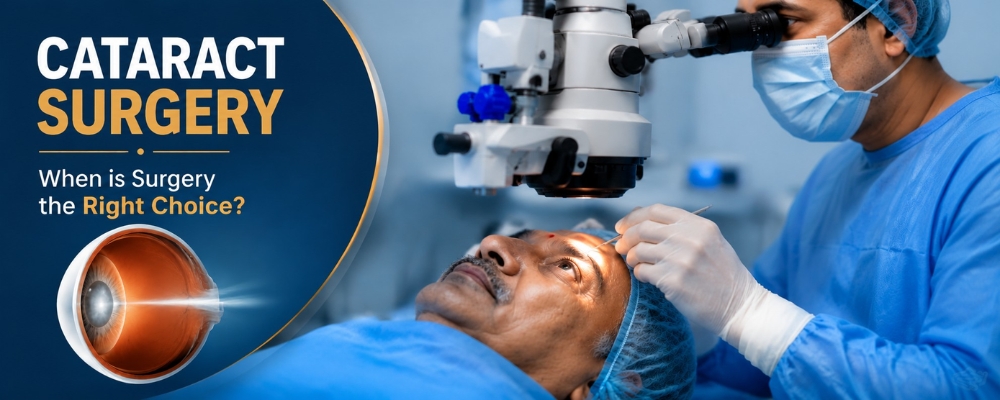
Cataract Surgery : When is Surgery the Right Choice?
Article Summary
Key takeaways from this article:
- Sometimes frequent changes in Glasses can help manage temporarily the early symptoms of cataract but they cannot stop the cataract from growing or restore the clarity that surgery provides.
- Cataract surgery is the only permanent solution for cataracts and is one of the safest, most commonly performed surgical procedures in the world today.
- The right time for surgery is not simply when the cataract reaches a certain stage but when it begins to significantly affect your quality of life, your ability to work, drive or carry out daily activities.
- Modern cataract surgery at Raghudeep Eye Hospital uses Femtosecond Assisted micro-incision phacoemulsification techniques and advanced intraocular lens options that can reduce or even eliminate in some cases the need for glasses after surgery.
- If you are struggling to see clearly even with your current prescription, it may be time for a cataract evaluation with our specialists in Ahmedabad or Jaipur.
Call Now for Quick Support

We’re Available!
What is a Cataract and What Does it Do to Your Vision?
The lens inside your eye is normally crystal clear. It focuses the light that enters your eye onto the retina, giving you sharp, clear vision. A cataract develops when this lens gradually becomes cloudy, due to changes in the proteins that make up the lens.
This cloudiness does not happen overnight. It develops slowly over months and years, and in the early stages, the changes to your vision may be subtle. You might notice slightly blurred vision, increased sensitivity to glare from headlights at night, colours appearing less vivid, or more frequent changes in your spectacle prescription. As the cataract matures, these symptoms worsen progressively.

The important thing to understand is that a cataract is a physical change inside the lens of your eye. No eye drops, vitamins, exercises or lifestyle changes can reverse this process once it has started. The only way to remove a cataract is through surgery.
Did You Know?
Cataract is the leading cause of treatable blindness in India. According to national data, approximately 6.2 million people in India are blind due to cataract, and a large proportion of them delay surgery for too long. Early evaluation and timely surgery can prevent this outcome entirely.
Glasses for Cataract: When They Help and When They Stop Working
In the early stages of cataract, a change in your spectacle prescription can sometimes improve your vision.
However, there are important limitations to what glasses can achieve:
- Glasses correct the refractive error caused by the cataract but cannot remove the cloudiness itself. As the cataract continues to mature, the scattering and cloudiness of the lens increases in ways that no prescription lens can compensate for.
- Frequent prescription changes become necessary as the cataract progresses. Patients often find themselves visiting the optician every few months for a new prescription, which is both inconvenient and costly.
- Glare, halos and poor night vision caused by cataract are not correctable with glasses. These symptoms arise from the way the cloudy lens scatters light, and a spectacle lens placed in front of the eye cannot eliminate this.
- Reading vision and distance vision may deteriorate at different rates as the cataract changes the shape and density of the natural lens, making it difficult to achieve a single stable prescription for glasses that works well for all distances.
Our Services
Retina TreatmentCataract Surgery: What It Involves and Why It is Different
Cataract surgery today is a very different procedure from what patients might remember from previous generations. Conventional modern phacoemulsification, is performed through a micro-incision of just 2 to 2.2 mm. The cloudy natural lens is broken up using ultrasound energy and gently removed, More Advanced technique invoves Femtisecond Laser technology.In this laser assisted cataract surgery, microincision and cataract fragmentation is performed with the laser unlike manual conventional phacoemulsification. Our team at Raghudeep Eye Hospital at Jaipur and Ahmedabad have speciasised in these advanced technologies and refined techniques . Once the cataract is removed , an intraocular lens is implanted in the same location.
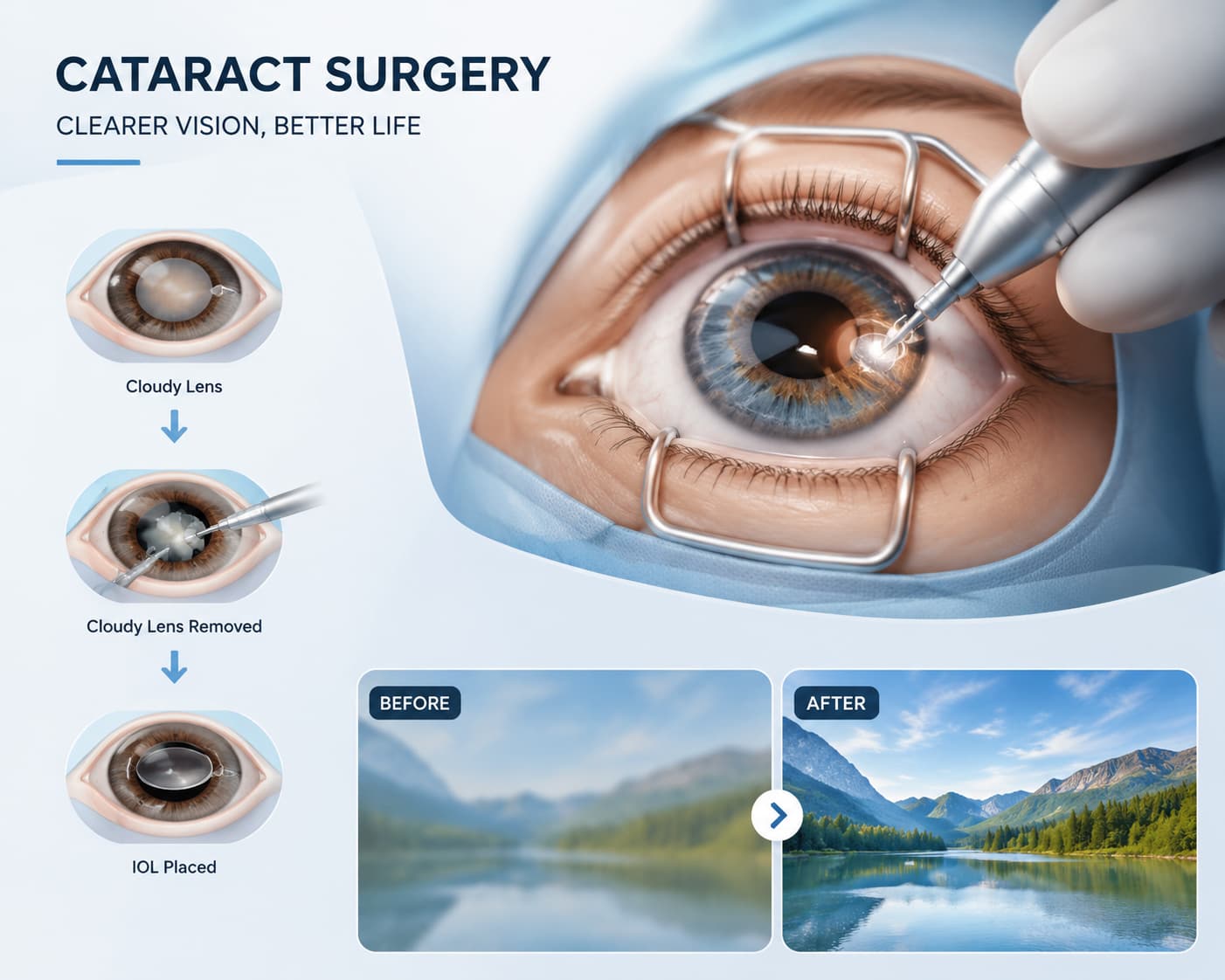
The procedure typically takes 15 to 20 minutes. It is performed under topical anaesthetic eye drops, where patient is awake but feels no pain. Patients go home soon after the surgery and typically notice a significant improvement in vision within 24 to 48 hours.
The Role of Intraocular Lens (IOL) Choice
One of the most exciting aspects of modern cataract surgery is the range of available intraocular lens options. Depending on your lifestyle, visual needs and eye health, our team at Raghudeep Eye Hospital can recommend the most appropriate intraocular lens customised for you.
- Monofocal IOLs: Standard lenses that provide clear vision at one distance. Most patients choose distance vision and use glasses for intermediate and near tasks.
- Multifocal IOLs: Premium lenses that provide good vision at multiple distances, significantly reducing or eliminating the need for glasses after surgery.
- Extended Depth of Focus (EDOF) IOLs: Advanced lenses that provide a continuous range of vision from distance to intermediate distance with fewer optical side effects than traditional multifocals. These patients typically would benefit by using reading aid for fine print.
- Toric IOLs: Lenses designed to correct astigmatism alongside various types of iols, improving the sharpness and overall vision quality. The toric component is available with monofocal, multifocal and Extended depth of focus lenses.
- Extended Depth of Focus (EDOF) IOLs: Advanced lenses that provide a continuous range of vision with fewer optical side effects than traditional multifocals.
The lens recommendation for your surgery is based on a devoted and thorough pre-operative assessment of your eyeprofile, your occupation, your lifestyle and your personal visual goals. This is a conversation our specialists will have with you in detail and help you to make a decision foe selecting the surgical technique for cataract removal and type of lens suited to you and your lifestyle.
Read Our Other Artilces
WHEN SHILD YOU GET CATARACT SURGERY DONE?
There is no universal rule that says a cataract must reach a certain stage before surgery is considered. The decision is personal and based on how much your cataract is affecting your daily life. Here are the signs our specialists look for when advising patients that surgery has become the right choice:
Consider cataract surgery if you are experiencing:
- Vision is blurred or hazy even with your most recent glasses or contact lens prescription
- You are updating your spectacle prescription more than once a year
- Glare from sunlight or car headlights is causing significant discomfort or affecting your ability to drive
- Reading, watching television or recognising faces has become difficult
- You have had to reduce or stop driving, particularly at night
- Your work, hobbies or daily activities are being affected by your vision
- You have monocular diplopia, meaning you see double or ghost images through one eye
- Colours appear yellowed, washed out or less vivid than they used to
- You feel unsafe doing things you used to do confidently because of your vision
- In nut shell , you should cosider cataract suegery if your visual difficulties bother you
OR - When an ophthalmologist feels that the cataract is likely to complicate the eye if not removed in a reasonable time.
Cataract Surgery at Raghudeep Eye Hospital in Ahmedabad and Jaipur
At Raghudeep Eye Hospital, cataract surgery is at the heart of everything we do. The Iladevi Cataract and IOL Research Centre, which is part of our hospital, is one of India’s most respected institutions for cataract research and innovation. This means our patients in Ahmedabad and Jaipur benefit directly from the most advanced surgical techniques and the best IOL options available anywhere in the country.
Our cataract surgeons perform phacoemulsification through micro-incisions that heal quickly with minimal discomfort. During a devoted time slot for the Pre-operative assessment is carried out meticulously at our hospital using state of the art technology , including advanced biometry, corneal topography , specular microscopy followed by a thorough discussion of IOL options tailored to each patient’s individual visual needs and lifestyle.
The decision to have surgery is not taken lightly. Our team takes the time to explain every step of the process, answer all your questions and help you feel completely confident and informed before proceeding. Whether you are at the early stages of cataract and wondering whether the time has come, or you have been managing with glasses for some time and feel your vision has deteriorated significantly, we are here to give you an honest, expert assessment.
Our Services
The Right Choice at the Right Time: Cataract Surgery That Gives You Your Vision Back
Surgery is the only solution that addresses the actual cause of the problem, and modern cataract surgery is safe, quick, highly effective and often life-changing.
The right time for surgery is when your cataract begins to affect your quality of life. Not when it reaches a certain grade on a medical chart but when you find yourself struggling to do the things you love, the things you need to do, or the things that keep you independent and safe.
If that moment has arrived, or if you are unsure whether it has, please come and speak to us at Raghudeep Eye Hospital in Ahmedabad or Jaipur. We will give you a complete picture of your eye health and help you make the decision that is right for you.
Frequently Asked Questions About Cataract Surgery
Frequently Asked Questions About Cataract Surgery
Is cataract surgery safe? What are the risks?
Cataract surgery is one of the most commonly performed and safest surgical procedures in the world. The overall success rate is very high, with the majority of patients experiencing significantly improved vision after surgery. As with any surgical procedure, there are small risks including infection, inflammation, posterior capsule opacification (a clouding that can occur months after surgery and is easily treated with a laser procedure) and, retinal complications. At Raghudeep Eye Hospital in Ahmedabad, our cataract surgeons conduct thorough pre-operative evaluations to identify and manage any risk factors before surgery, ensuring the safest possible outcome for every patient.
How long does cataract surgery take and will I need to stay in hospital?
The procedure itself typically takes 15 to 20 minutes per eye. Cataract surgery at Raghudeep Eye Hospital is performed as a day procedure, meaning patients go home the same day. There is no overnight stay required. You will need someone to accompany you home after surgery and you should plan to rest for the remainder of that day. Most patients can return to light activities within 24 to 48 hours and notice a clear improvement in vision very quickly.
Will I still need glasses after cataract surgery?
This depends on the type of intraocular lens chosen for your surgery. With a standard monofocal IOL, most patients achieve good distance vision and use reading glasses for near tasks. With premium multifocal or extended depth of focus IOLs, many patients find they can manage daily activities without. The lens recommendation is personalised based on your lifestyle, occupation and visual needs. Our team at Raghudeep Eye Hospital will discuss all the options with you in detail during your pre-operative consultation so you can make an informed choice.
Can both eyes be operated at the same time?
In most cases, we operate on one eye at a time, with a gap of few days to weeks between the procedures. This allows the first eye to heal and stabilise before the second eye is treated, and also allows us to refine the IOL selection for the second eye based on the outcome of the first surgery. In select cases, bilateral same-day surgery may be considered, but this is discussed individually with each patient based on their specific circumstances.
What is the cost of cataract surgery?
The cost of cataract surgery depends on several factors including the type of IOL selected, the surgical technique used and any additional pre-operative tests required. At Raghudeep Eye Hospital, we offer cataract surgery with a range of IOL options at different price points to suit different budgets and visual requirements. We recommend booking a consultation with our team for a detailed evaluation and a personalised cost estimate. Our team will explain all available options and help you choose the one that best matches your vision goals and budget.
At what stage of cataract should surgery be done?
There is no fixed rule about the exact stage at which cataract surgery should be performed. The decision is based on how much the cataract is affecting your daily vision and quality of life. In earlier times, surgeons recommended waiting until the cataract was very mature before operating. With advanced phacoemulsification techniques used at Raghudeep Eye Hospital, surgery is safer even when a cataract is advanced as well as when it is in its early stage. If your vision with glasses is no longer satisfactory, if you are struggling with glare or night driving, or if your daily activities are affected, it is the right time to consider surgery regardless of the technical stage of the cataract.
Start a Chat on WhatsApp

We’re Available!
About the Author
Dr. Abhay R. Vasavada
M.S. Ophthalmology, F.R.C.S. (Ophth. England) | Founder Director, Raghudeep Eye Hospital & Iladevi Cataract and IOL Research Centre, Ahmedabad
Dr. Abhay R. Vasavada is a surgeon, research scientist, author and mentor who has become one of the most important voices in establishing phacoemulsification as the global standard for cataract surgery. He completed his Masters in Ophthalmology from the Maharaja Sayajirao University of Baroda in 1975 and was awarded the Fellow of the Royal College of Surgeons, England (F.R.C.S.) in 1980.
He is the Founder Director of Raghudeep Eye Hospital and the Iladevi Cataract and IOL Research Centre (ICIRC). He has more than 250 peer-reviewed publications and has trained over 150 national and 50 international ophthalmologists. His awards include the Binkhorst Gold Medal (ASCRS 2011), the Dr. B.C. Roy Award, an Honorary Doctorate from the University of Hungary, and the prestigious Harold Ridley Medal Lecture at ESCRS 2024, making him the first Indian ophthalmologist to receive this honour.
Dr. Vasavada has served as President of APACRS from 2020 to 2022 and is a keynote speaker and live surgery demonstrator at major international conferences across the USA, Germany, Italy, Hungary, the Middle East, Asia-Pacific and Australia.